Competition
Economics concept #14

Everyone knows how competition works. You try to beat your opponent. Simple. If you perform better than they did, you win and they lose. Or they perform better, so they win and you lose.

This is yet another word that doesn’t mean quite the same thing in economics that it does in common usage. Competition simply means that market participants don’t trade in a vacuum; there are others making similar trades, and if your potential trading partner trades with someone else, they don’t need to trade with you. Every Coke product someone buys likely means one fewer Pepsi product they buy. However, from the producers’ point of view, the goal is not to “beat” other producers. It’s to make a profit. Whether a business owner’s competitors are profitable doesn’t matter to them, unless they can learn something from those competitors to become more profitable themselves.
In the same way, consumers can be said to compete with each other, since anything one person buys can’t be bought by someone else. This usually isn’t a problem, because producers don’t want to lose sales by not making enough of something and running out, but occasionally it happens when there’s an increase in demand or decrease in supply that happens too suddenly for producers to adjust in time, or when a seller sets their asking price below the market equilibrium.
Consumers and producers even compete against each other in a way. Each of them wants as large a part of the economic surplus from a trade as possible. However, as long as each side of the trade gets some of the surplus, they’re better off than before, even if the other side gets more. This was especially true of barter, where skilled bargaining to maximize your own surplus was a valuable skill:
At last Mr. Brown said, “Well, ma’am, I’ll trade you the milk-pans and pails, the colander and skimmer, and the three baking-pans, but not the dishpan, and that’s my last offer.”
“Very well, Mr. Brown,” Mother said, unexpectedly. She had got exactly what she wanted. Almanzo knew she did not need the dishpan; she had set it out only to bargain with. Mr. Brown knew that, too, now. He looked surprised, and he looked respectfully at Mother. Mother was a good, shrewd trader. She had bested Mr. Brown. But he was satisfied, too, because he had got plenty of good rags for his tinware.
(“Farmer Boy” by Laura Ingalls Wilder)
The modern equivalent would be a group of customers deciding that the asking price for something is too high, and doing without that particular product until it goes on sale. There’s no direct negotiation, no explicit statement from them to the seller that the price is unacceptable. There’s just a shelf full of unsold product, which is a clear message by itself. The idea that sellers can just set whatever price they like fails to account for the fact that someone has to be willing to pay it.
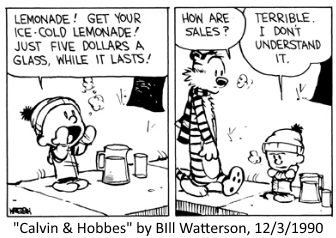
But back to the main form of competition, seller versus seller. Nobody has to lose, but in some circumstances someone will lose. When there are too many sellers, or not enough buyers, one or more sellers may not be able to sell their goods for a profit, because the equilibrium price is less than their cost of production. When this happens, they have a few options:
Continue to sell at a loss, which makes sense if they think the situation is temporary.
Offer different goods for sale if they have that capability, which can expand their pool of potential buyers.
Exit the market – that is, stop producing and trading those goods completely.
Each option has a different effect on the equilibrium price. We’ll look at what those are, and how they happen, next time.