Shifting the Supply Curve
Economics concept #15


Bad news for Greg the baker. The other bakers in his community – Helen, Irene, and Julio – have each developed their baking techniques to the point that they can produce bread efficiently enough to sell at a lower price and still be profitable enough to stay in business. Greg, for whatever reason, is less efficient, and the total cost for him to produce bread is higher than what he can sell it for. That means his business is running at a loss. What should he do?
The first instinct might be to raise prices, but that doesn’t work. If he asks more than the market equilibrium for his baked goods, most people will just buy from his competitors instead. Unless...unless he can somehow convince potential buyers that his products are better than theirs, or even just different enough that they offer something specific that his competitors don’t offer. In other words, he could try to differentiate his products with marketing. Marketing – which just means trying to convince potential buyers that your product offers utility for them – is not technically part of economics, but it’s important to understand it because it affects demand.
Greg’s marketing of his better/different baked goods will slightly increase demand for those goods and slightly decrease the demands for their substitutes (Helen, Irene, and Julio’s baked goods). How much, and for how long, we can’t tell without more information. It depends on how much better or different they are. Marketing can encourage people to try a product, but whether they buy another will depend on the utility they get from the first one.
If it doesn’t work in the long run, or if Greg doesn’t think marketing will help (maybe because his products really aren’t that different from his competitors’ products), he may have to get out of the baking business to put an end to his losses. Regardless of what he moves on to after that, let’s take a look at what happens to the baked goods market in this community.
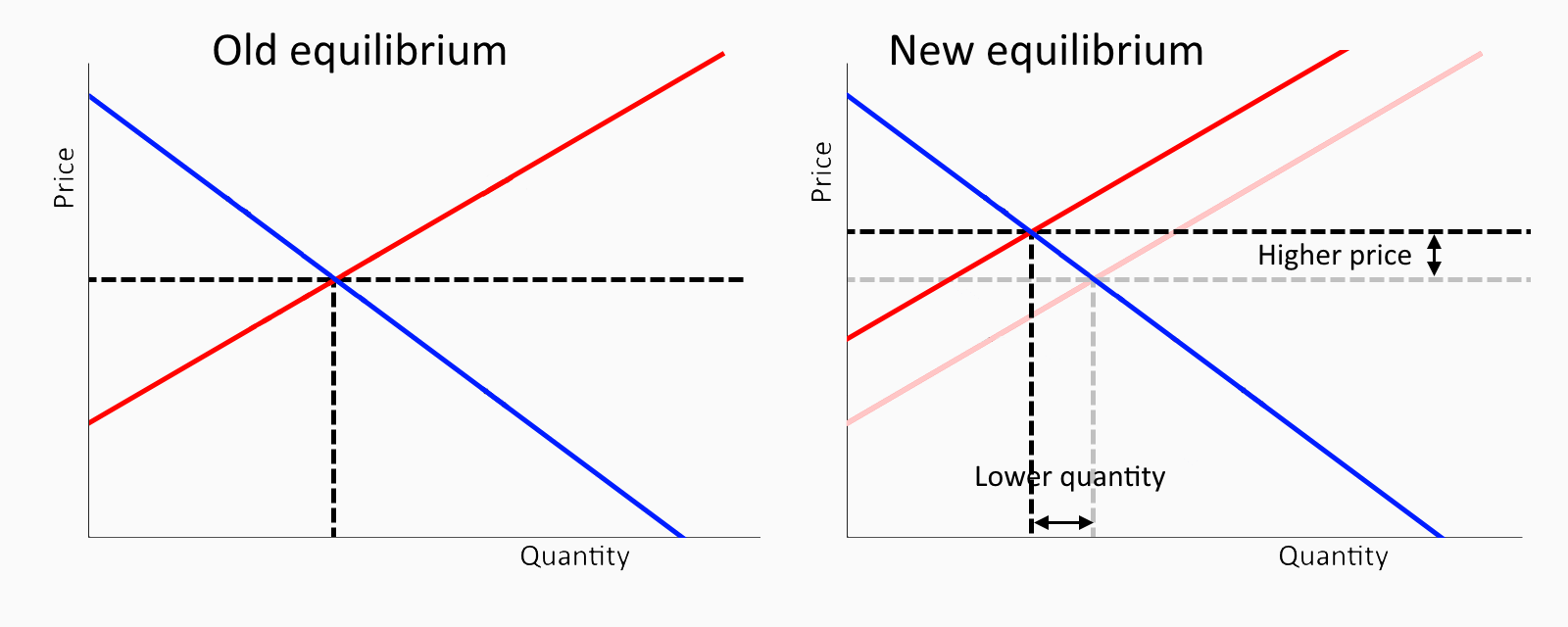
Remember how the aggregated demand curve represents the total quantity sellers are willing to produce at each price? Greg’s production was part of that curve, and now that part of the production is gone. Illustrating that, the supply curve shifts to the left, meaning that the quantity available from producers at each price is lower. The demand curve hasn’t moved – people still want the same amount of bread at each price as before – but the supply curve shift means the two curves cross at a new equilibrium. The equilibrium quantity, unsurprisingly, is lower. But that’s not all: the equilibrium price is higher. This also shouldn’t be a surprise, since bakery customers are competing against each other for now-scarce goods.
But the actual price may not change. We need to keep in mind that the equilibrium price and the market price are not the same thing. Sellers – in this case the other bakers – don’t get notified when the equilibrium changes. But they will notice over the next few weeks that they’re selling more than they have before. At that point they’ll either increase their production, which will move the supply curve back toward where it started, or raise prices.
Which will it be? That will depend on whether they have the capacity to increase production quickly and how they think customers will react to higher prices. The popular image of greedy business owners setting prices as high as possible aside, it’s common for sellers in some markets to sell at prices below the equilibrium, because “below the equilibrium” doesn’t mean “at a loss.” They’re still making a profit. The equilibrium describes the market as a whole, not an individual seller. If an individual seller has a choice between selling 500 units of product at a profit of $1 each or selling 400 units at a profit of $1.15 each, the first one makes more sense. “Greed” (actually self-interest) can result in a lower price instead of a higher one.
Competition also matters. If one baker decides to raise prices and another baker decides to increase production, the first one loses customers and the second gains them. Each baker knows this already, and doesn’t want to lose market share to a competitor. Even if none of them have the ability to increase production, so they do in fact raise prices, “greed” will encourage them to invest in equipment to increase the amount they can supply. These are a few of the ways that the market price and quantity gradually move toward the equilibrium price and quantity, as discussed a few posts ago.
The demand curve can also shift, of course...