Trade
Economics concept #4

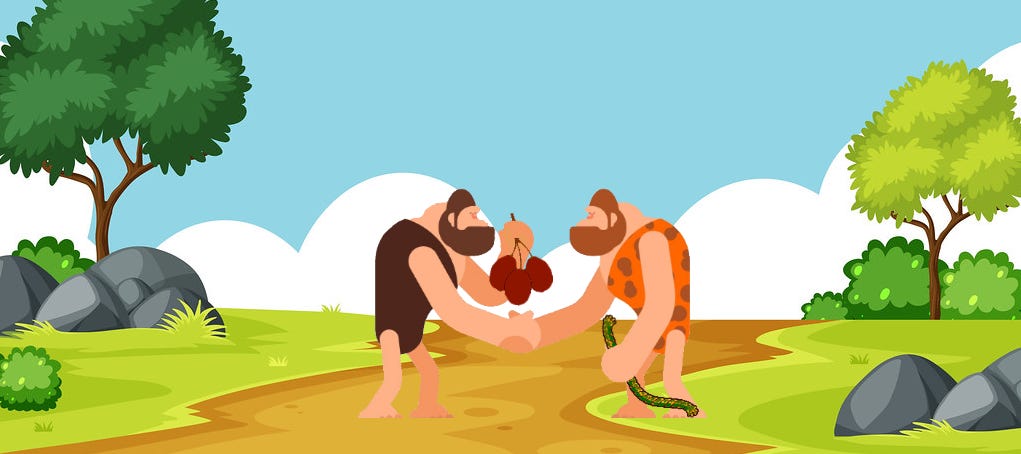
So where were we with Thag? Ah, right. He made a rope from grass, combining his labor and a natural resource to create a new piece of valuable property that belongs to him. And now he’s decided to transfer his ownership – his authority over that grass rope and how it’s used – to Unga. Why would he do that?
Maybe he wants to show Unga that he’s friendly, so that they’re more likely to cooperate for their mutual benefit in the future.
Or he wants to show Unga that he’s useful, because Unga is strong and potentially dangerous.
Or he thinks it’s likely that Unga will reciprocate in some way when Thag needs something in the future.
Or he and Unga are part of the same tribe, and sharing sets an example for others and increases Thag’s social standing.
Or Unga already provided some benefit to Thag in the past, and Thag is repaying a social obligation.
Or Thag simply knows that Unga needs the rope for some reason, and is happy knowing that Unga has it.
In all of these cases, the same principle that generally guides our choices applies: Thag gives his rope to Unga because what he gains by doing it, even if that gain is intangible, is worth more than the rope.
There is another possibility, though. Maybe Thag and his fellow cavemen have discovered the concept of trade, and Thag is giving his rope to Unga in exchange for something Unga is giving him right now – maybe some fruits Unga picked from a nearby tree, growing high enough to avoid being eaten by other animals.
Which one of them is better off as the result of this trade? Or to look at it another way, which one is getting more value than they give up? Can we even tell?
The answer is both. At first, this may not make sense. How can both sides get more than they give when each side is getting what the other gave? And the answer is simple: because there is no such thing as the objective value of a grass rope, or a certain number of fruits. Each person determines the value of a good individually. The value of the rope to Unga is more than the value of the fruits to Unga, and the value of the fruits to Thag is more than the value of the rope to Thag.
At first, it seems like we’re assuming a lot about Thag’s and Unga’s thought process. But it’s not an assumption. We have clear evidence of how they each value the fruits and the rope: both Thag and Unga agreed to the trade. Both sides of a consensual trade believe themselves better off as a result. If that weren’t true, the trade wouldn’t happen.
Without consent, it’s not trade. It’s just theft, robbery, or extortion depending on the details. Those things certainly happen, among cavemen and unfortunately among modern humans, but they’re topics for criminologists and sociologists to explain, not economists.