Marginal Utility
Economics concept #5

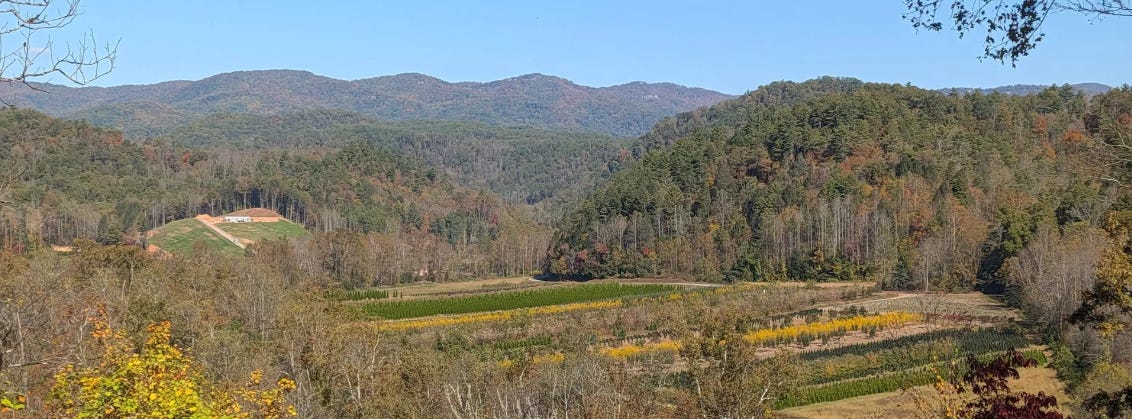
Let’s move forward to the more recent past. Alice, one of Thag’s descendants, lives in a mountain valley with her husband Bob somewhere in Appalachia in the late 1700s. We’re still before electricity and motor vehicles, so for now we can treat their homestead as completely isolated.
By “their homestead,” we mean the area they have cleared of trees and rocks so they can use it. In economics, this property is referred to by the extremely creative term land. The homestead also includes the house, shed, and fence that provide some protection from the elements and animals; these are referred to as improvements. Land and improvements are both part of real property, which is better known outside of economics, accounting, and law as “real estate.” This real estate is Alice and Bob’s property because, like Thag’s rope, it consists of only natural resources and their labor.
The opposite of real property is personal property, which consists of everything other than land and improvements. In this case, everything inside the house and shed is Alice and Bob’s personal property; tools, dishes, furniture, and so on. These property terms aren’t super important, but they’re defined here because ideologues attempting to pass themselves off as economists often conflate them with other terms.
For now, let’s look at this land. Since Alice and Bob cleared it, they must have believed that the benefit of having it cleared was enough to justify the labor it took. So why didn’t they clear even more? If a certain amount of cleared land is worth more to them than a certain amount of labor, wouldn’t the same be true of twice as much land and twice as much labor?
Well, no. Remember that utility isn’t a fixed amount. It can be altered by a lot of factors, and one of those factors is quantity. In economic terms, marginal utility – that is, the utility of adding one more square foot of cleared land, or one more potato or throw pillow or whatever – diminishes as the amount you already have increases. There are other factors in Alice and Bob’s decision, of course, but marginal utility is what we’re looking at right now. The labor needed to clear land remains more or less constant, but the utility of each new bit of cleared land decreases as it adds up. Eventually, the trade of labor for land is no longer favorable, and at that quantity it no longer makes sense to expend more labor.
Marginal utility, along with opportunity cost, will also be part of Alice and Bob’s decisions about what crops to plant on their homestead. Opportunity cost matters because everything they plant will reduce the amount of land available to produce something else. Diminishing marginal utility will lead them to plant a good amount of each crop instead of planting the bare minimum of everything and then filling the rest of the land with their favorite – let’s say that’s carrots – because the more carrots they have, the less value one more carrot has. At a certain quantity, the utility from another carrot will be less than the utility from another...whatever their second-favorite is. And so on with the second-favorite compared to the third-favorite, all the way down their mental list of preferences.
Like many concepts in economics, marginal utility is complicated to describe, but simple in practice. You and billions of other humans take marginal utility into consideration when making decisions without needing to analyze it.