Indifference and Surplus
Economics concept #6


Back to Alice and Bob, who have a comfortable living on their homestead by the standards of their time. A combination of natural resources and their labor, augmented by various tools like shovels and plows, allows them to meet their present needs and provide for the future.
Let’s change the scenario. Rather than being completely isolated, they live a mile or so from a town. Every Saturday, they bring excess produce to the town square market to barter with others, trading a good they have for a good someone else has. If they trade, say, five pounds of carrots for a dozen eggs, that tells us two things (we’ve been over this before, but repetition can be helpful). First, they wanted a dozen eggs more than they wanted five pounds of carrots. Second, David the chicken farmer wanted five pounds of carrots more than he wanted a dozen eggs.
If the trade had been different, would they still have agreed to it? What if David had asked for a hundred pounds of carrots? Probably not. So somewhere in between five pounds and a hundred pounds is an amount of carrots that would be an even trade as far as they’re concerned. They might or might not make this hypothetical trade since it wouldn’t increase or decrease the utility of what they have. In economics, this is referred to as indifference, which means the same thing it does in normal use: not really caring one way or the other.
The difference between the trade they were indifferent to and the trade they got is called economic surplus. If their indifference point was trading nine pounds of carrots for a dozen eggs, then trading five pounds for the eggs represents an economic surplus of four pounds of carrots. We could also measure it in terms of eggs using a similar approach. David also has economic surplus, which could be measured in eggs or carrots.
Considering both trading parties’ indifference points lets us determine the economic surplus of the entire trade. If Alice and Bob would be indifferent trading nine pounds of carrots for the dozen eggs, and David would have been indifferent trading the eggs for three pounds of carrots, then the total surplus is six pounds of carrots - the difference between each side’s indifference point.
We can handle a little bit of math, right? That surplus will be divided in some way between the traders, with the details depending on how they negotiate.
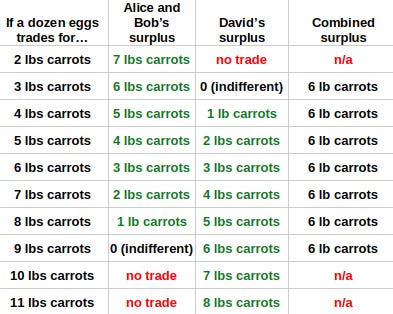
Barter was the standard form of trading for most of human history (and likely prehistory), but had some shortcomings. Each trade had to be negotiated separately – after all, each person’s indifference point is different, so each pair of traders’ acceptable range is different. Even more of a problem, barter only worked if each side had something the other wanted. If David didn’t like carrots, for example, Alice and Bob would have a hard time obtaining eggs.
If only there was a way to make trade more efficient…