Money
Economics concept #7

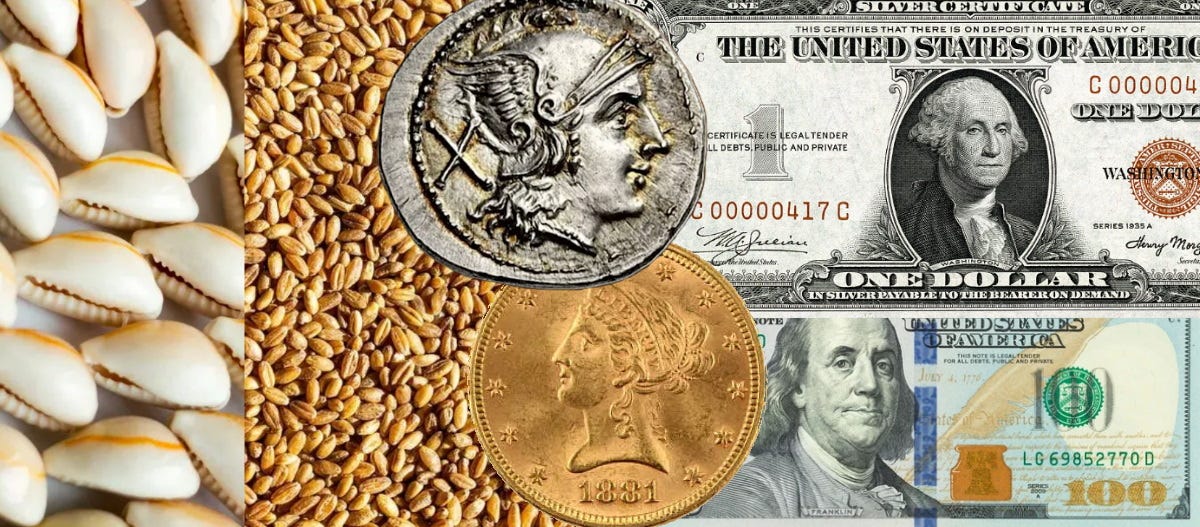
If you asked a random person to explain what economics was about, there’s a pretty good chance that their answer would involve money. And while that might not be technically correct in all the details, it’s true that money is a big part of economics. But what is money, really?
In the most fundamental sense, money is something that people will accept in a trade not because it offers them utility in and of itself – also called intrinsic value – but because they expect other people to accept it in trade for the things they value. The oldest form of money is commodity money – goods that do have intrinsic value in addition to their use as money. Imagine for a moment that Alice and Bob’s carrots are so well known for consistent quality that half the people in town consume them. Other people, even the ones who don’t eat carrots themselves, would likely trade for them because they could turn around and trade them for things they did want.
Carrots are not a great form of money, though. Money needs to have certain characteristics:
It’s portable in quantities large enough to trade for most items. Carrots probably aren’t valuable enough to carry enough to buy anything expensive.
Each one is more or less identical to others. Carrots aren’t all the same size, although maybe Alice and Bob could find a way to make that happen.
It can be traded repeatedly without being damaged, and doesn’t deteriorate over time. Root vegetables are more durable than other forms of produce, but they still aren’t likely to last for more than a few weeks if they’re being carried around instead of stored properly.
It’s difficult to make more of it (or fake versions of it). This is definitely not true of carrots.
Unsurprisingly, carrots don’t get used much as money. Seashells, various dried grains, livestock, animal furs, spices, alcohol, cigarettes, and of course precious metals have served as money at various times in various places. Reading that list, you may have thought “hey, that one is missing some of the characteristics above too,” and you’re right. There’s no such thing as perfectly functional commodity money. Precious metals are the most usable of the group, which is why they were so popular.
Governments all over the world made precious metals more usable by creating coins – basically pieces of precious metals stamped with a government design to guarantee weight and purity. Of course, governments being what they are, they eventually debased this money, replacing some of the metals with less expensive ones, which meant the coins were less valuable so that it took more of them to buy things. This decrease in the value of money is called inflation, something that’s still a problem today, although for slightly different reasons.
Modern coins look fairly similar to ancient (or just old – the US gold dollar was minted through the late 1800s) coins, but they are not commodity money. Most of them are made with fairly inexpensive metals. They have essentially no intrinsic value. The government says they’re worth a certain amount, and everyone sort of just goes along with it. This type of money is called fiat money. Its main drawbacks are that 1) the government can keep creating more, which leads to inflation, and 2) no matter how intricate it is, some people will figure out how to make counterfeit (fake) versions of it. Our paper money is also fiat money, as is the electronic money we transfer from bank to bank instead of using physical money. I’m not going to go into the monetary system right now, since it deserves an entire article (maybe more than one) on its own and is far more math-heavy than anything we’ve looked at so far.
Anyway, the use of money instead of barter has advantages other than making trade more convenient and less dependent on who needs what at a certain point in time. Not only can people buy and sell with it, they can save it up for major purchases, borrow and lend it more easily than commodity money, and use it to measure values in a way anyone can understand. That last point is going to be important going forward, because there will be some math (not super complicated math, I promise), and dollars are easier to calculate with than carrots or eggs or loaves of bread.