Demand
Economics concept #8

All right, let’s say that the market where Bob and Alice trade is using money instead of barter, which will help us measure values more easily. “Market” in this case doesn’t just mean the physical location where people meet – it refers to the people themselves. A market is a group of buyers and sellers who all have the ability to do business with each other. So we could talk about not just the market in town, but the market for a specific product.
Specifically, let’s look at the market for Bob and Alice’s carrots. That would be Bob and Alice, plus everyone who visits the town market today and is interested in buying carrots. To keep it simple, we’ll assume that there are only four carrot buyers. Each of them get some utility from carrots, and like anyone else, if that utility is more than the price and they have the money, they’ll trade. But remember, marginal utility means that they won’t be willing to pay as much for more carrots once they already have some. Carl, for example, who REALLY likes carrots, will buy 10 pounds if the carrots are 2¢ a pound, 8 pounds at 3¢, 6 pounds at 4¢, 5 pounds at 5¢, 4 pounds at 6¢, and 3 pounds at 7¢ or 8¢. Other buyers have different preferences, but all of them will buy more carrots at a lower price than at a higher price.
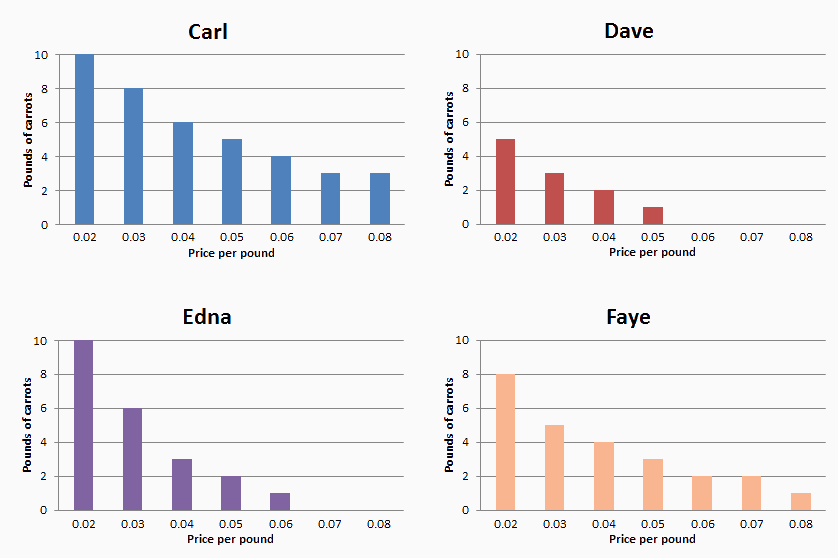
We could have made this easier by using a good that people are likely to buy only one of, like a specialized tool or a night in a hotel room, which would have meant we didn’t have to look at marginal utility for each person. But a lot of goods in real life are things people buy in quantity.
Of course, Bob and Alice don’t really care who buys the carrots. From their point of view, selling a few pounds of carrots to Dave is the same thing as selling a few pounds of carrots to Faye. What matters to them is aggregate demand – the total number of carrots everyone is willing to buy. To get that, we just add up the demand from Carl, Dave, Edna, and Faye.
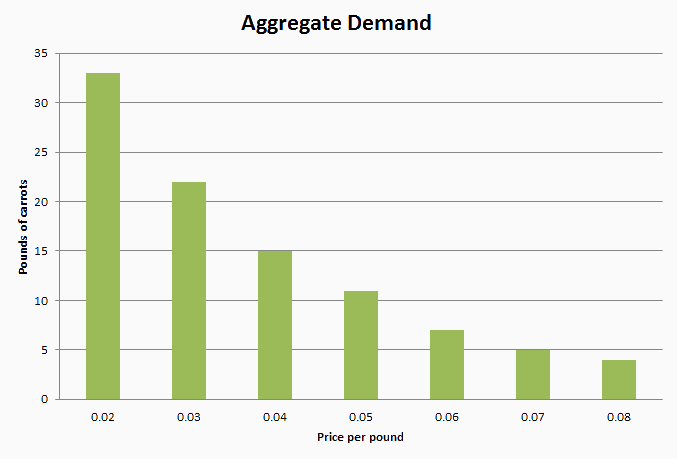
If Alice and Bob only brought 15 pounds of carrots to the market today, and if they have a good understanding of their potential buyers’ price ranges, they’ll likely offer them for 4¢ a pound. If they ask for more, they’re likely to end up with unsold carrots at the end of the day. If they ask less, they’ll have customers wanting to buy carrots when they don’t have any left to sell.
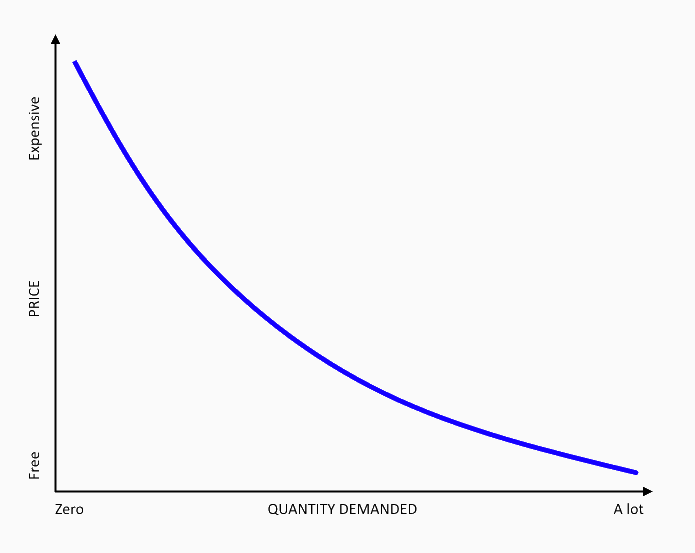
In the modern world, with a huge number of potential buyers, our aggregate demand graph would have way too many bars to be useful. Instead, we use a demand curve (which looks like a line graph, but in a way it’s a scatter plot with so many points so close together that they aren’t individually visible) to describe aggregate demand.
It’s important to remember that a demand curve doesn’t show the prices people are willing to pay, but the quantity of goods that all buyers combined are willing to buy at each price.
Isn’t that the same thing, though?
Nope. Remember, people will trade if what they get is worth as much as or more than what they give up. Or to put it another way, the selling price is not the value of the item. It’s equal to or greater than the value of the item in the opinion of the buyer, because otherwise they wouldn’t buy it. Whatever price a seller sets, a small number of buyers will be indifferent – to them it’s simply a fair price – but the rest are paying less than their indifference price. That’s the economic surplus we talked about earlier in the series.
Sellers get economic surplus too, but that will have to wait.