Supply
Economics concept #9

Well, of course we have to talk about supply now. We just looked at demand, and everyone has heard of “supply and demand,” right? They’re like peanut butter and jelly.
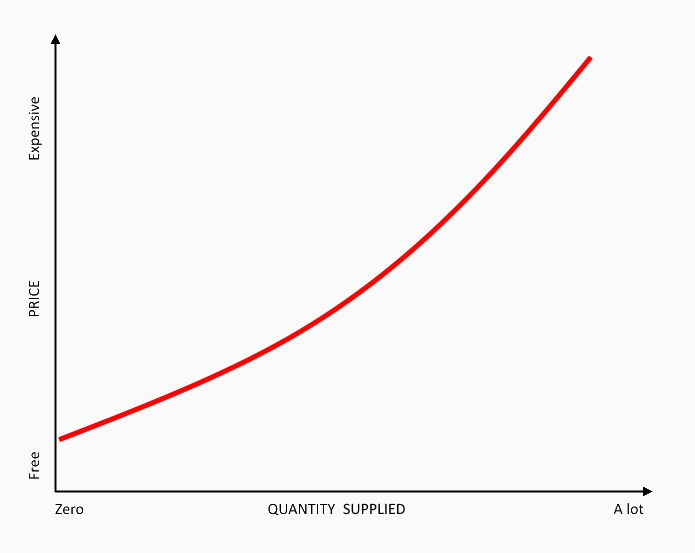
The supply curve, predictably, has a shape that’s basically the opposite of the demand curve. Just like buyers will buy more at a lower price, sellers will sell more at a higher price. Simple, we’re done.
Well, no, we’re not done. Yes, the outcome is easy to understand, but how and why it works that way is a little more complicated and a little less intuitive. Most of us have a lot of experience in trade as buyers, but little or none as sellers. The first major difference between supply and demand is when the decisions that determine those things happen. A seller has to offer something for sale before people can buy it, and has to produce it before that. And first of all, they have to decide how much to produce – or if they should produce it at all.
Let’s say our hypothetical seller is Greg the baker, who wants to offer bread for sale at the farmer’s market. He considers the cost of all the ingredients, and to understand the real cost also adds a bit for wear and tear on the oven and mixing bowls and pans and utensils he’ll eventually have to replace, and the electricity or gas to do the baking. He also needs to put a value on his time – because that’s part of the opportunity cost of baking as well.
Whatever total cost he comes up with, he’s going to need to charge more than that for his bread. The cost of production is the absolute minimum price he should offer to sell it for – if people won’t pay that, he’s better off not making bread for sale at all. Some will almost certainly pay more than that, though, because Greg’s experience and skill means that he can make bread at a lower opportunity cost then they can, so they are better off buying his bread and spending the time they would have used making their own on something else. Every other person willing to sell bread, whether they’re actively pursuing it as a business or not, faces the same choice as Greg, even if they’re not consciously aware of it.
The supply curve is the combination of all potential bread producers’ answers to the question “would you make bread if you could sell it for this price?” Obviously there are more people willing to sell bread if the price is higher and fewer if it’s lower. At prices lower than the lowest possible cost of production, there are no sellers. Free bread is a nice fantasy, but that’s what it is – a fantasy.
The reason it’s a curve and not a horizontal line – that is, the reason that different sellers have different minimum prices – is simply that some can produce bread at a lower cost than others. Better equipment, better prices on materials (maybe they buy in bulk and/or have an agreement with a supplier), or a carefully planned routine that allows time to be used more effectively can all contribute to the difference.
So now we’ve got supply, and we’ve got demand. Next, as you may have guessed, we’ll see what happens when we combine them to get the famous “supply and demand.”